“The church has largely settled on one way of naming God to our great poverty. The blessed, holy Trinity is one way and only one way of naming the God of many names.” 1 ~ Wil Gafney
Context
Lectionary texts: Genesis 1:1–2:4a; Psalm 8; 2 Corinthians 13:11–13; Matthew 28:16–20
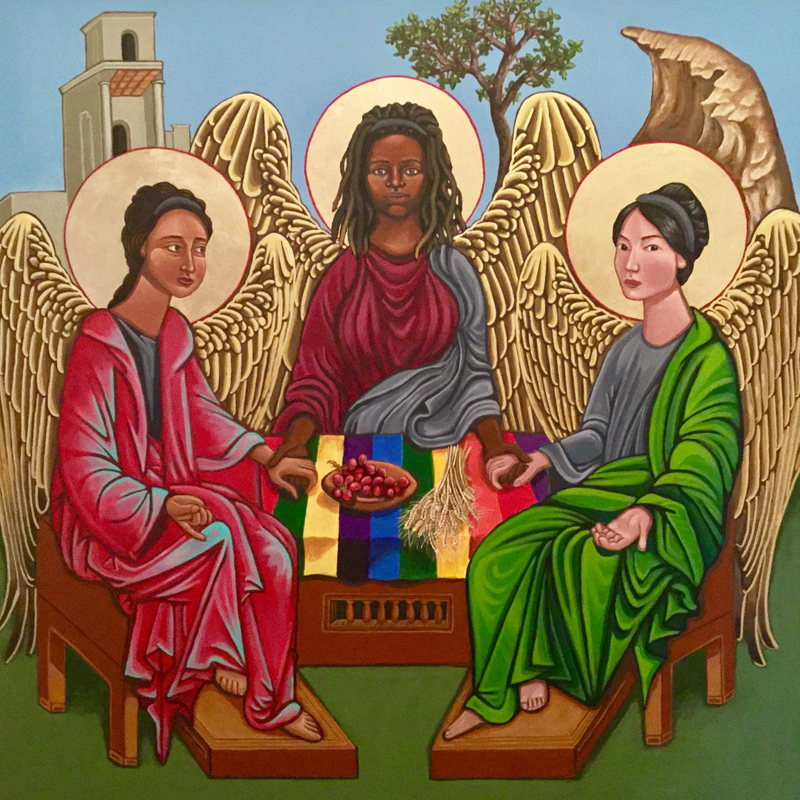
Trinity Sunday is the second Sunday in the Pentecost season. This week’s lectionary texts, when read together, tell the story of God’s work in, with, and through humanity. The Genesis and Psalm passages highlight the work of Creator God. In Matthew 28, Jesus commissions his disciples to baptize in the name of the Father, Son, and Holy Spirit. Paul closes his 2nd letter to the Corinthians with the blessing: “The grace of the Lord Jesus Christ, the love of God, and the fellowship of the Holy Spirit be with you all,” (13:13, CEB) which many understand to imply that Jesus, God, and the Holy Spirit are one.
Devotional
Recently, I was talking with a mentor about what has become the church’s default way of referring to the three persons of the Trinity: “Father, Son, and Holy Spirit.” We both agreed that the word father carries many connotations, some positive and some negative, depending on who you ask. When it comes to drawing closer to God, father sometimes blocks the path rather than clearing it.
Then my mentor said, “And Son is problematic because that’s also giving God a gender.”
I remarked that I have no problem with Jesus, a human man, being referred to in masculine terms. His response gave me pause:
“But you’re talking about Mary’s son. I’m talking about the Son who was with God from the beginning.”
(So, this is taking a turn into Theo-Nerd territory. The TL/DR version is that the Council at Nicaea happened in 325 CE, where church leaders debated whether Jesus was of the same substance as God, or a being made by God. “Same substance” won the day and the Nicene Creed was, in part, an outcome of that debate.)
But here’s what we need to remember: Some men who had privilege and authority in the church, who wanted to retain the political favor of Emperor Constantine, made a decision in 325 CE that drew a hard line around the Holy Trinity. The church has been reading scripture, writing theology, praying prayers, and singing hymns through this lens ever since. Unfortunately, we have largely ignored the many other ways scripture talks about God.
Biblical scholar and Episcopal priest Dr. Wil Gafney writes:
God is beyond numbering and naming. The scriptures use many more than three names or images to describe God and do not limit us to any. And the scriptures do not mention the Trinity at all. Three names make a nice poetic flourish. But God is not bound or limited by our limitations. God is One, and Two – Incarnate and Incorporeal, and Three and Seven (the “seven spirits of God” in Rev 3:1; 4:5; 5:6) and God is Many and Ineffable.2
When we limit the ways we name God, two things happen: First, we fail to see the myriad of ways in which God works in our lives, transforming and empowering us through infinite and divinely creative means. Hope, then, becomes harder to grasp. Second, we narrow the lens through which others may spot themselves in the holy mirror, reflecting God’s image as God’s created and beloved. These negative outcomes do the most harm to marginalized people already struggling to find themselves in God’s story. By discovering and restoring the many names of God, we are resurrecting the voices and gifts of LGBTQ+ people and others who have been oppressed. We are opening ourselves to more fully hearing the voice of God, who is still speaking.
“Do this in remembrance of me” involves more than the receiving of bread and wine. We are also invited to remember and receive the Bread of Life and the Living Water. In our worship, the church should be stating and repeating other names for God just as often as we repeat Father, Son, and Holy Spirit. Repetition builds remembrance of the infinite ways in which God’s perfect love exists to comfort, change, and embolden us.
Let Trinity Sunday remind us that God has many names. Three is just the start. Three tells us there’s mystery to be explored, and names yet to be discovered.
Prayer
God of Many Names and Faces, we give thanks for your presence and work in our lives. We are too limited to fully name or explain you, yet we know you to be true. May we seek you in all things, remembering that the great I AM is more than sufficient to travel with us and surround us with perfect love. In the name of the Father, Son, and Holy Spirit – the Mother of us all – amen.
Liturgy
Prayers, Sermons, Responsive Readings, Spoken Word
Wil Gafney has written trios of names for God such as:
Author, Word, and Translator
Creator, Redeemer, and Sustainer
Sovereign, Savior, and Shelter
Majesty, Mystery, and Mercy
Creator, Christ, and Compassion3
Gafney’s full list can be found here. Try writing these into prayers, sermons, chants, and responsive readings.
Hymns
God of Many Faces
Just as God has diverse names, Amy Cerniglia’s hymn “God of Many Faces” celebrates the many ways in which the image of God is made known through the diversity of nature, genders, and bodies. Verse 1 reads:
God of many faces, we offer our praise
Singing your glory through all of our days
Hear ever-growing voices once fragile, now strong
Carrying melodies in expansive new songs.4
All four verses of the hymn, as well as the tune, are published on page 23 of Songs for the Holy Other, which is available for free download from the Hymn Society. (See the Donate button on the Hymn Society’s webpage to make a financial contribution to their work if you can.)
Doxology
Gilbert H. Viera’s adaptation of the Doxology is set to the tune most commonly known as “All Creatures of Our God and King.” It is on page 94 of The United Methodist Hymnal. Viera starts with the traditional Doxology lyrics but then switches courses, specifically naming various ways in which God works:
Praise God, the source of all our gifts!
Praise Jesus Christ, whose power uplifts!
Praise the Spirit, Holy Spirit!
Alleluia! Alleluia! Alleluia! 5
Poem
This untitled work by Brian G. Murphy, posted April 8, 2026 on his Instagram account, @thisisbgm, reads:
gay bars are altars
to the dreams of our
closeted youth.

you made it.
let the choir sing.

i twirled with the Spirit on the dance floor of a gay bar.

she liked my swishy hips
i liked her bright smile.

she ran her fingers through my hair,
shook the shame out of my soul,
and whispered,

“what if you can be who you are?”
Visio Divina
- Reflect on one or both of the icons below.
“The Trinity” by Andrei Rublev
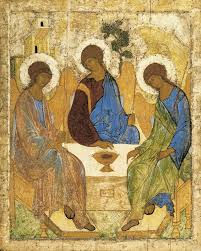
“The Holy One in the form of Three—eating and drinking, in infinite hospitality and utter enjoyment between themselves. If we take the depiction of God in The Trinity seriously, we have to say, ‘In the beginning was the Relationship.’” Art historians suspect that the piece originally had a mirror glued to it. “But can you imagine what its meaning might be? It’s stunning when you think about it—there was room at this table for a fourth. The observer. You!”6
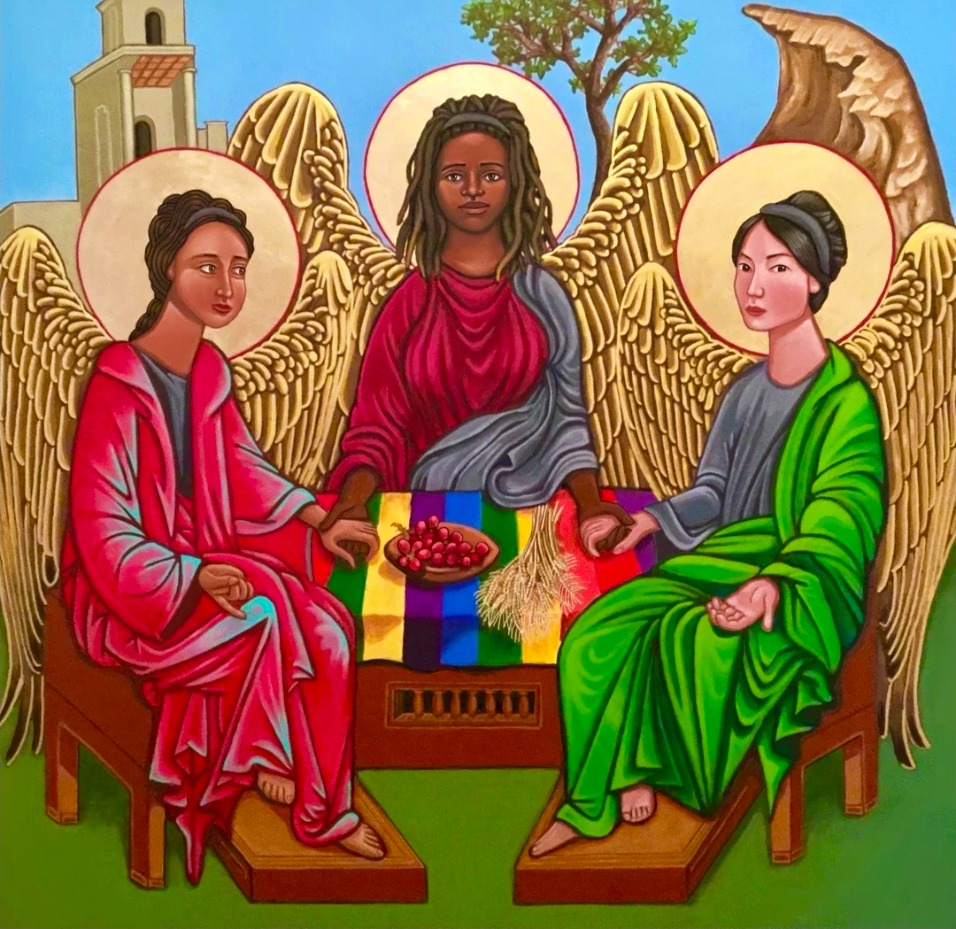
“The Trinity” by Kelly Latimore
- Exercise: Compare and Contrast
Show Rublev’s icon to the congregation and ask them to think of some words to describe what type of emotion or spiritual insight it elicits. Next, show them Latimore’s icon and ask the same question. Then, reflect on how reactions to each icon differed. Was there one that resonated more? Why? Did either icon make you uncomfortable? What does it mean to you to see women of color representing the three persons of the trinity? What can we learn about ourselves from these icons? What can we learn about God?
Sources:
- Wil Gafney, “Naming and Numbering: God of Many Names on Trinity Sunday,” Womanists Wading in the Word, accessed April 18, 2026, https://www.wilgafney.com/2016/05/17/naming-and-numbering-god-of-many-names-on-trinity-sunday/ ↩︎
- ibid ↩︎
- ibid ↩︎
- Amy Cerniglia, “God of Many Faces” in Songs for the Holy Other (The Hymn Society, 2019), https://thehymnsociety.org/resources/songs-for-the-holy-other/ ↩︎
- Gilbert H. Viera, “Praise God From Whom All Blessings Flow” in The United Methodist Hymnal (Abingdon Press, 1989), 94. ↩︎
- Richard Rohr with Mike Morrell, The Divine Dance: The Trinity and Your Transformation (Whitaker House, 2016), Kindle, 29-30. ↩︎
 Jennifer Noricks
Leave a comment