Effective worship communicates “the story of God’s ongoing relationship with humanity…enabling the congregation to see themselves as part of this story.”1 ~Ruth C. Duck
Context
All those who follow in the way of Jesus are called to become more like him, our actions infused with Divine Love that draws others to know God for themselves. When United Methodists make or affirm our membership covenant with the local church, we promise to “faithfully participate in the ministries of the church by our prayers, our presence, our gifts, and our service, that in everything God may be glorified.”2 As church members, we prioritize the ministry of the church, a body called to radical inclusion, over our individual tastes and preferences in worship so that in everything – and in everyone – God may be glorified.
Devotional
“God is spirit, and it is necessary to worship God in spirit and truth.” (John 4:24, CEB)
What’s the difference between worshiping in spirit and worshiping in truth? Worshiping in truth is something we do with our minds. What we believe in our minds directs our actions. Worshiping in spirit occurs when that truth is internalized. It often stirs deep emotion. We know it in our core, in our spirit. This is what transforms us.
Sometimes, worshiping in truth is the most we can do. Not every bit of liturgy is relatable to every person. Not every element of the worship service is meaningful to each person. To graciously participate in worship practices not intended for you is to choose to embody love for your neighbor. You are choosing to worship in community because your mind knows that’s what you’re called to do. Each person attending worship services will, at some point, find themselves worshiping in truth, but having a hard time worshiping in spirit.
To graciously participate in worship practices not intended for you is to choose to embody love for your neighbor.
Seeing ourselves in the story of God is how we move from worshiping in truth to worshiping in spirit, but LGBTQ+ people have fewer opportunities to see ourselves in that story. We patiently sing hymns that describe God only in masculine terms and make heteronormative assumptions about our family structures. We are expected to show grace to people whose lives are different from ours so that they can worship in spirit, but less frequently is that grace offered to us. We can worship in truth, but opportunities to worship in spirit are more limited for us.
A fresh look at our hymns and worship songs opens the possibilities for others to see themselves in the story of God. Non-traditional family structures may include single and divorced people, same-sex couples, people estranged from their family members, and more. Reducing references to God as “he” makes room for women and non-binary people to see themselves more fully in the story of God. Acknowledging and celebrating the diversity of congregants promotes an atmosphere for everyone to worship in spirit and in truth.
Prayer
God Who is Our Peace, you have broken down every wall. Forgive us for constructing barriers that have excluded others from fully worshiping you. Comfort us when communal worship makes us uncomfortable. We long to worship in spirit and in truth, that you might be glorified. May fresh perspectives in our music place a new song in our hearts. Amen.
Liturgy
Here are several strategies for practicing radical inclusion in worship music lyrics. My goal is to honor the lyricist’s intended message while maintaining the meter. Sometimes, a one-to-one substitution (such as “God” instead of “him”) is all that’s needed. Other times, you may need to get more creative. Collaboration with others on such a project is helpful.
Adapt Lyrics in Your Current Repertoire
The United Methodist Hymnal and subsequent songbooks have adapted quite a few (but not all) lyrics that refer to God in the masculine. It retained binary language referring to human genders. Here are a few examples of adaptations I’ve made.
For the Beauty of the Earth3
Original: For the joy of human love: brother, sister, parent, child
Adaptation: For the joy of human love: fam’ly, sibling, parent, child
All Creatures of Our God and King4
The lyrics vary from hymnal to hymnal. They are identical in Sing to the Lord (the official hymnal for the Church of the Nazarene) and The Celebration Hymnal. Those are the lyrics I’ve labeled “Original” below. Meanwhile, The United Methodist Hymnal contains verses not seen in the other two hymnals. I’ll talk more about those verses in the next section on Balancing Gender References.
Original: All creatures of our God and King, lift up your voice and with us sing
Adaptation: All of creation praises bring, lift up your voice and with us sing
Original: O praise him! Alleluia (found in older hymnals)
Adaptation #1: O praise ye! Alleluia (adaptation in The United Methodist Hymnal)5
Adaptation #2: O praise God! Alleluia (mine)
Original: And worship him in humbleness
Adaptation: And worship now in humbleness
Original: Praise, praise the Father, praise the Son / And praise the Spirit, Three in One!
Adaptation: Praise to the Holy Trinity / Who was and is, Will always be.
The Servant Song6
Original: Brother, sister, let me serve you.
Adaptation: Will you let me by your servant?
Balance Gendered References
If you simply cannot find a way to remove gendered language from a song whose message is top-notch, find ways to reference multiple genders. When I say multiple genders, I mean more than two. Pairs like she/he or mother/father still exclude non-binary and other gender-expansive identities.
All Creatures of Our God and King7
The United Methodist Hymnal contains verses referring to “brother wind,” “sister water,” “brother fire,” and “mother earth.” The words “king” and “him” are used once each. I might swap out a “brother” for a “sibling,” or “they” for “him.”
Praise, My Soul, the King of Heaven
The United Methodist Hymnal made a great adaptation that serves as an excellent example of balancing gendered references.
Original: Father-like, He tends and spares us / Well our feeble frame He knows; In His hands He gently bears us / Rescues us from all our foes.8
Adaptation: Father-like, God tends and spares us / Well our feeble frame God knows; Mother-like, God gently bears us / Rescues us from all our foes.9
Goodness of God
Original: I’ve known you as a father, I’ve known you as a friend. 10
Adaptation: I’ve known you as a shepherd,11 I’ve known you as a friend.12
Choose Different Songs
I KNOW! We have those songs we just love and the thought of letting them go is almost unthinkable. But remember this: Just because you remove it from the congregation’s repertoire doesn’t mean you have to remove it from your personal playlist. Sing it at home and in the car. Don’t let your personal preferences become a barrier to marginalized people in your worship service.
Good, Good Father13
For the repeated references to God as father, we have several options:
Adaptation: Sing “you’re a good, good parent” or “you’re a gentle shepherd” or “you’re a loving savior.” Let Biblical descriptions of God be your inspiration to get creative.
Substitution: Swap it out for a song that refers to God as a loving parent without using gendered language. Try “God of Many Faces” from Songs for the Holy Other.
Alternate: If you just can’t stop yourself from singing about God as a loving father, also sing about God as a loving mother. Ancient Love by Carolyn McDade is beautiful.
Doxology
Finding new ways to talk about the Trinity is tough when “Father, Son, and Holy Ghost” has been the church’s preferred language for centuries.
Adaptation: OLD 100TH14 is the tune most commonly used. Every time you see the lyric “him” change it to “God.” My church still sings the word “father,” but by making the other changes, we’ve at least reduced the gendered language by 67%.
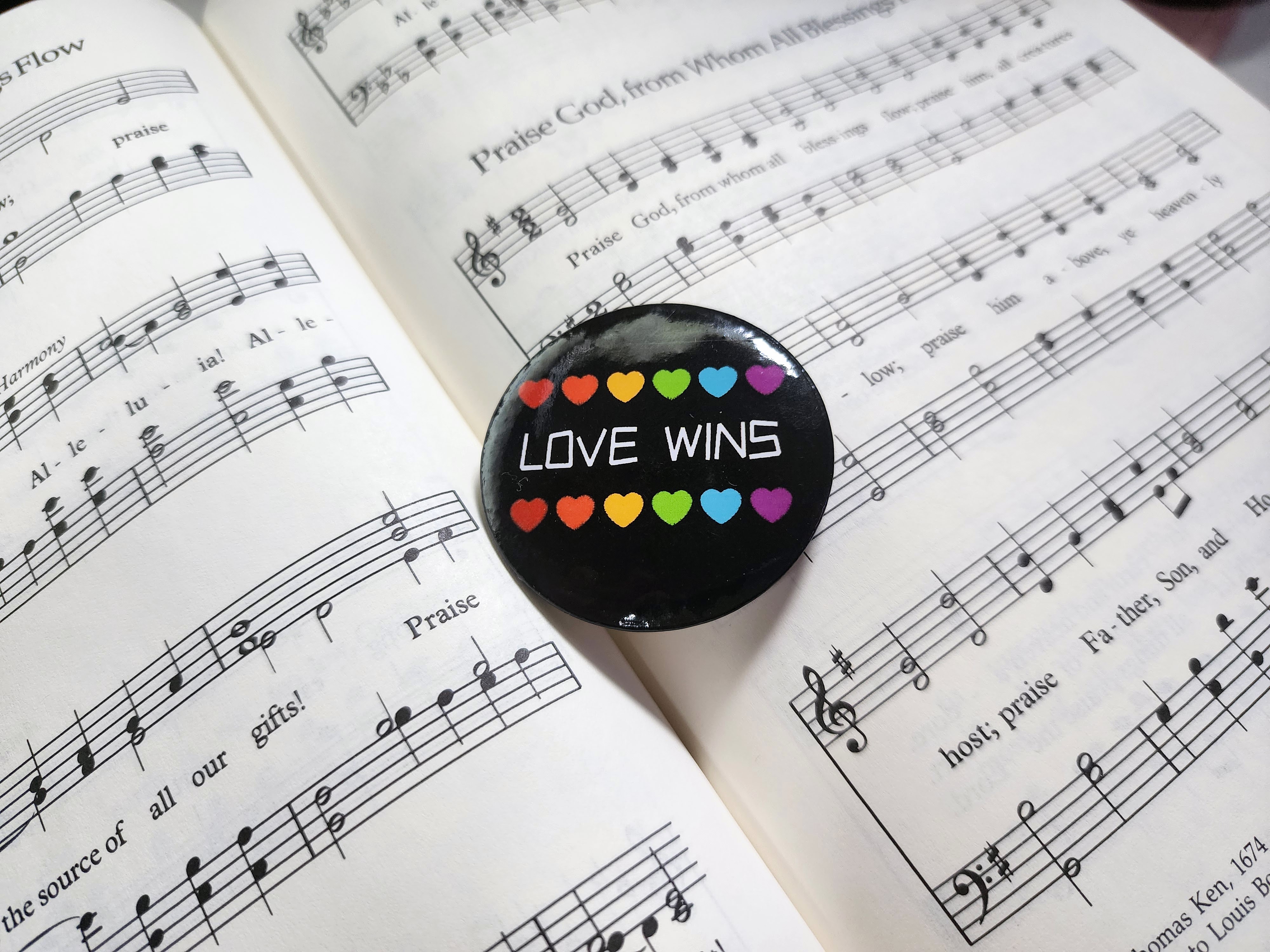
Alternate: Or, try a different doxology, like this one on page 94 of The United Methodist Hymnal. Set to the tune of “All Creatures of Our God and King,” Gilbert H. Viera adapted Thomas Ken’s lyrics, telling us the name and work of each person of the Trinity without using gendered language:
Praise God, from whom all blessings flow;
Praise God, all creatures here below:
Alleluia! Alleluia!
Praise God, the source of all our gifts!
Praise Jesus Christ, whose power uplifts!
Praise the Spirit, Holy Spirit!
Alleluia! Alleluia! Alleluia! 15
Don’t let your personal preferences become a barrier to marginalized people in your worship service.
For Everyone Born
The tune and the title of this song vary. One version (titled “A Place at the Table,” lyrics by Shirley Erena Murray, tune by Lori True) appears in the United Methodist songbook, Worship & Song, p. 3149. This was published before the UMC officially took an affirming stance on LGBTQ+ inclusion, so the lyrics fail to mention that there’s a place at the table for queer folx. Instead, I recommend the adaptation by Avery Arden at breakingbinaryworship.com.
Get New Songbooks
Finally, I highly recommend Songs for the Holy Other: Hymns Affirming the LGBTQIA2S+ Community. This hymnbook, curated by the Hymn Society, contains original songs appropriate for congregational singing. Some of the pieces consist of new music and lyrics, some contain new lyrics set to familiar tunes. The hymnal is available for free download. (Don’t miss the “Donate” button in the upper right corner of their webpage.)
Simply reading the lyrics to many of these songs has given me a fresh perspective on queer theology and the experiences of my queer siblings as we move through a world not made for us. Let us be known as a church that is made for all.
Sources
- Ruth C. Duck, Worship for the Whole People of God, 2nd ed. (Westminster John Knox Press, 2021), Kindle, 36.
↩︎ - “The Baptismal Covenant I” in The United Methodist Hymnal, (Abingdon Press, 1989), 38. ↩︎
- Folliot S. Pierpoint, “For the Beauty of the Earth” in The United Methodist Hymnal (Abingdon Press, 1989), 92. ↩︎
- Francis of Assisi, “All Creatures of Our God and King” in Sing to the Lord (Lillenas Publishing Co., 1993), 77; Francis of Assisi, “All Creatures of Our God and King” in The Celebration Hymnal: Songs for Hymns and Worship (Word Music/Integrity Music, 1997), 63. ↩︎
- St. Francis of Assisi, “All Creatures of Our God and King” in The United Methodist Hymnal (Abingdon Press, 1989), 62. ↩︎
- Richard Gillard, “The Servant Song” in The Faith We Sing (Abingdon Press, 2000), 2222. ↩︎
- St. Francis of Assisi, The United Methodist Hymnal ↩︎
- Henry F. Lyte, “Praise, My Soul, the King of Heaven” in Sing to the Lord (Lillenas Publishing Co., 1993), 42. ↩︎
- Henry F. Lyte, “Praise, My Soul, the King of Heaven” in The United Methodist Hymnal (Abingdon Press, 1989), 66. ↩︎
- Jenn Johnson, Jason Ingram, Ben Fielding, Ed Cash, & Brian Johnson, “Goodness of God,” accessed July 20, 2025, praisecharts.com/72290. ↩︎
- Jenn Johnson, et. al, “Goodness of God,” lyrics adapted by Richard Hinkelman, 2026. ↩︎
- In a private conversation, Richard Hinkelman stated that he’s also substituted “I’ve known you as provider” for “I’ve known you as a father,” as well as other words that suit the scripture and sermon of the day. ↩︎
- Pat Barrett and Anthony Brown, “Good, Good Father” (Capitol Christian Music Group, 2015). ↩︎
- Thomas Ken, “Praise God, from Whom All Blessings Flow” in The United Methodist Hymnal (Abingdon Press, 1989), 95. ↩︎
- Thomas Ken, “Praise God, from Whom All Blessings Flow,” lyrics adapted by Gilbert H. Viera, tune: LASST UNS ERFREUEN in The United Methodist Hymnal (Abingdon Press, 1989), 94. ↩︎
 Jennifer Noricks
Leave a comment